|



 |
|
General info about Tasmania
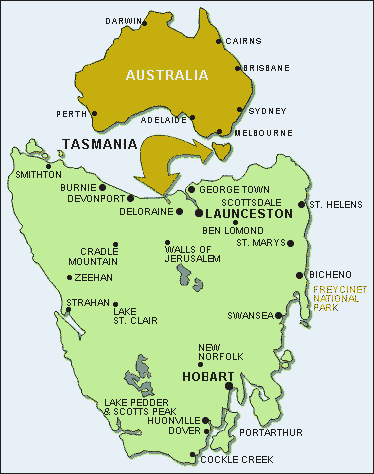 TASMANIA is a state of Australia, 240km south of the mainland. It's as big as Ireland with only 1/10 of it´s population. It is the holiday destination of your dreams. The unique experience has to be seen to be believed. It has everything you could want: vast places of natural beauty, untamed wilderness, lively modern cities and areas of great historic interest. All this in a mild, temperate climate and with a local population of the friendliest people you could hope to meet. It is simply an ideal place for outdoor activities. There is relatively little traffic on the beautiful country roads; the changeable landscape provides endlessly interesting scenery. Not to forget the many empty beaches on a 3,200 km long coastline, and the cleanest air in the world (in the northwest). There are 17 National Parks on the island and more than 20% of the total land area is listed as World Heritage! The Overland Track is situated here and is considered one of the top walking tracks in the world. TASMANIA is a state of Australia, 240km south of the mainland. It's as big as Ireland with only 1/10 of it´s population. It is the holiday destination of your dreams. The unique experience has to be seen to be believed. It has everything you could want: vast places of natural beauty, untamed wilderness, lively modern cities and areas of great historic interest. All this in a mild, temperate climate and with a local population of the friendliest people you could hope to meet. It is simply an ideal place for outdoor activities. There is relatively little traffic on the beautiful country roads; the changeable landscape provides endlessly interesting scenery. Not to forget the many empty beaches on a 3,200 km long coastline, and the cleanest air in the world (in the northwest). There are 17 National Parks on the island and more than 20% of the total land area is listed as World Heritage! The Overland Track is situated here and is considered one of the top walking tracks in the world.
The main island rises from flat coastal areas up to 1000m on the central plateau. There are significant mountain ranges in the Northwest and several spectacular off-shore islands. In just one day's cycling you can pass through different vegetation zones and experience 'four seasons' of weather; it will literally 'blow you away'! When you don´t like the weather, just wait. It really is true that you can experience 'four seasons in one day'!
The travel guide "Lonely planet" has once classified the West coast of Tasmania as the second best cycling route in the world!

Plants and Animals
Not many of the animals and plants on the island could be considered dangerous. Commonly seen animals include; wallabies, wombats, echidnas, black swans, platypuses, possums and, of course, the famous Tasmanian Devil.
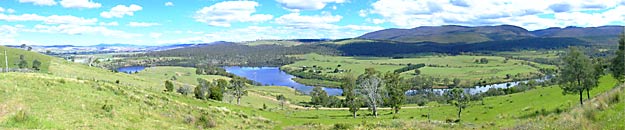
The Tasmanian countryside is so varied; there is everything from rainforest to coastal scrub, rolling green farmland, open eucalypt forest, pine plantations, subalpine mountain country and beautifully landscaped parks.
History
Climate
 |
One of the very pleasant features of Tasmania is the distinct four seasons that occur here. Summer is much more pleasant than on the mainland; not so hot, very seldom humid, and it cools down during the night. The most stable weather is towards the end of summer. Autumn brings stunning light effects and because of European trees being planted in the cities, lovely, seasonal colour changes can be observed. Winter invariably brings snow cover to the mountain tops and a lovely stillness. The air is fresh and the water clean.
The main summer months of January and February have temperatures around 24ºC (75ºF) nevertheless, the sun is VERY intense. You need good protection; hat, sunglasses, sunscreen, etc.
|
Best time to travel
 |
The 'high season' in Tasmania is late December, January and early February; its also the warmest time of year. Avoid the days around New Year´s Eve in Hobart and the first two weeks in January on the East coast. The most stable weather usually occurs in late February and March. You will also find the best light for photography in March. As far as cycling is concerned spring and autumn can be lovely and less crowded, but the days can be a bit chilly, especially at night.
|
How to get here
 |
One of the reasons Tasmania still feels so unspoiled is because it is simply so far away from the rest of the world, but it is REALLY worth the effort! It’s around 22 hours flying time from Europe; a bit less from the US. Most international airlines fly into Sydney or Melbourne (Australia), where you'll have to clear customs (usually fast and easy) and board a domestic flight to Launceston or Hobart. If you are booked on one of our group tours, we will greet you at the airport. Note: You may need a visa, see below.
|
VISA requirements
 |
Citizens from curtain countries must hold a current travel visa to be allowed to enter Australia. An electronic visa (called eVisitors) is easy to get free of charge and valid for 1 year, but only 3 months long visits are allowed each time. There have been a lot of changes recently due to covid 19. Please check the Immigration office website. Note: Be honest in answering the questions and mind the restrictions. DO NOT bring ANY food into Australia!
|
Pictures
 |
If you want to see more pictures of beautiful Tasmania then view our web gallery. To go back to this website just close the browser window.
Some of the photos displayed are taken from Dan Fellow´s CD-Rom 2000 stunning photos of Tasmania.
|
|